Tom Palmer keeps them coming; the wonderful stories from WWII and after, some of them set in the Lake District. Angel of Grasmere is the latest, beginning in 1940, soon after Dunkirk.
Tarn and her friends roam the fells, partly looking for invading Nazis, but also because it’s what children did. Tarn’s older brother was lost in the retreat from Dunkirk, and her family no longer feels complete.
But Tarn has her friend Peter and their new pal Eric, an evacuee from Manchester. Their story is a good way of learning what life during the war might have been like, and it’s shocking how close the was came, to somewhere that feels quite distant both from Europe and the south of England.
There seems to be an angel in the neighbourhood, someone who carries out acts of kindness in various ways. It makes people feel better, thinking someone is looking out for them.
In a way their lives are quite ordinary, and yet not at all. This is a lowkey kind of war story, making you feel good about seeing the actions of this angel, as well as seeing how grown up these 11-year-olds could be. Because they had to.
And the setting is lovely, between Grasmere village and up towards Easedale Tarn.
I have always loved Sally Nicholls’s writing, and here is another book for Barrington Stoke on an important subject. It’s about stepparents. They can be horrible (can’t we all?). And they can be nice. Too nice.
That is Abby’s problem. She was happy with her life and all of a sudden she needs to accommodate a woman who is very nice, very kind, who tries very hard. When what most of us want is to continue being comfortable in our own homes; not having to be polite to a stranger.
Step families are probably more common than I tend to think, so lots of readers will want to know how to deal with any such situation.
Abby’s father is a little naïve, I think. Abby’s maternal grandparents are quite interesting…
We went into Waterstones. For fun, as Daughter put it.
What she really wanted to do was check out their boardgames.
Meanwhile I looked at their fantasy nook. I could always buy myself a new Terry Pratchett, and preferably not one on the list Daughter and the Resident IT Consultant carry round with them. (I live in hope for my birthday.) But while they had half a dozen or so, none of them were ones I needed.
Stepped sideways to the next nook. The one housing crime. The new Sara Paretsky was published – in the UK – on Thursday. I already have my copy, but wanted to see if they did too. They didn’t. And after a while I worked out why. They don’t seem to stock any hardbacks. They are – as I frequently complain about – so very large. I’d say they wouldn’t fit on the shelves.
It’s an interesting concept, though. Can you really not sell a book when it’s first out, but expect your customers to wait for the paperback? I suppose they’ll say you can order it to collect, bypassing the shelves.
Some new hardbacks were displayed near the doors, on tables, where I spied Percival Everett’s novel, James. I pointed meaningfully at it as we passed. But no Pay Dirt.
Your witch has a guest on here today; Barbara Henderson on her new novel:
“Isn’t language wonderful? Some words have an impact far beyond their literal meaning. How apt then that I should write about the witchcraft angle in The Boy, the Witch and the Queen of Scots for the Bookwitch blog. Nothing could be more fitting!
Scotland has form when it comes to witches and warlocks, particularly following the Scottish Witchcraft Act of 1563 when both the practice of witchcraft and consulting with witches became capital offences, punishable by death. Shockingly, Scotland executed at least 15 times as many witches as England relative to its population. The act came into effect during the troubled reign of Mary, Queen of Scots. In 1597, her son King James VI of Scotland (and later I of England) became the only European monarch to publish a treatise defending the reality of witchcraft. Is it the dark nights of winter|? The dreich, foggy weather? Whatever the reason, the supernatural has always occupied a key place in the Scottish psyche.
My book, The Boy, the Witch and the Queen of Scots, is set just before the Scottish Witchcraft Act comes into force – but my characters already inhabit a world which is steeped in religion and superstition. It was an age of fear – the plague was ravaging Europe, wars and counterwars spilled across borders and as if that wasn’t enough, you had to remain wary of witches and devils, too.
The idea to make a little more of this angle in the story arose when I read up on one of the villains in my story, the Earl of Huntly, also known as the ‘Cock o’ the North’ on account of his showy and proud conduct. Keen on a Catholic counter-reformation, the Earl staged a revolt against the newly arrived Queen when she refused to be manipulated by him. And guess what – his wife, the Countess of Huntly, is rumoured to have been partial to witchcraft. Soon, the very association with sorcery was to carry the death penalty. It inspired fear. It generated power. It made one feel invincible, perhaps. It is said that the Earl’s wife received a witches’ prophecy that her husband would emerge from the final battle without a wound on his body. This proved true, if not in the way she expected – the Earl was captured and died of ‘apoplexy’ (probably a stroke or seizure). Queen Mary was victorious.
Of course, prophecies and witchcraft also gave me the opportunity to put one of my main characters in danger through vicious and false accusations: a young seamstress called Lizzie simply repeats a prophecy she has overheard. When the events prophesied come to pass, she is accused of witchcraft and treason, and dragged away to Edinburgh’s notorious Tolbooth prison. Witchcraft may not carry the death penalty yet, but treason most certainly does. The stakes could not be higher for my young protagonists.
And then there is the title. Initially, the book was called The Queen’s Hawker. Not bad – but where was the jeopardy? A rethink was needed. The Spy and the Queen of Scots? Yes, better. But then I discovered the existence of a novel for teens called Spying for the Queen of Scots, by Theresa Breslin, an author I respect and admire greatly. Time for another rethink, no doubt about that. The Boy and the Queen of Scots? It was one of my teacher friends, Steven Kenyon, who had read the novel draft and suggested the threefold title: The Boy, the Witch and the Queen of Scots.
Once more, aren’t words great? My work here was done. That single additional word delivers threat, drama, jeopardy, intrigue, and an echo of the iconic The Lion, the Witch and the Wardrobe. It took me a while to get there, but I have arrived – with the supernatural angle firmly embroidered into the story, as if by Mary’s own hand.
I went looking for my rather ancient, and quite small, copy of Huckleberry Finn. It wasn’t there. OK, I thought, it was old. I was given it as a school prize in 1968.
But then the little grey cells kicked in. I thought that I have more than one place for books. And I consider Huck Finn to be a children’s book. So I’d have put it with children’s books, not with adult fiction. Dead simple. And there it was.
I have been reading about Percival Everett who has written a retelling – James – seen through Jim’s eyes. It sounds like the kind of thing I’d like to read. I think so, anyway. But 1968 was a long time ago, and I had already read the book when it was presented to me, in English. Presumably because I had been studious and did well at English. Still looked daunting, and it was only my second book in English, after the Ladybird book I bought two years earlier.
Because I did know the story, I was never tempted to try it in a foreign language. It’s just been sitting there for 55 years. It looks it, too, with its yellowing pages and brown spots.
I’m guessing it was chosen as a sequel to the likelier Tom Sawyer – which I’d also read – and as one of very few books available in English, for children, in the local bookshop. The price is still there, in pencil. Five kronor 40 öre.
Having come across more than one reference to Huck recently, I’ve felt guilty because I can only remember snatches of the plot. And I know it’s [been] considered very important in the US. Percival Everett is the same age as me. But it seems he only read an abridged version as a child, followed by the full book in his teens.
Perhaps I don’t need to feel any shame over my lack of recall. My copy of Huck is 370 pages, so I hope it’s not abridged. I think I might reread it. Then James.
Read in The Bookseller what Jenny Niven, the new director of the Edinburgh International Book Festival, said about everything that is new. Her, the venue, new plan, new strategy.
Sounds like they will make the audiences work harder; less of this sitting quietly while the authors speak. (We shall have to see about that.)
The discussion with the dissenting writers is still ongoing. (We shall have to see about that, too.)
And then I studied the photo of Jenny, as you do. All I could think about was what lovely green trousers she was wearing… And then I realised that I have never considered, or noticed, what Nick Barley wore. Some kind of suit, I imagine. Shirt and tie, probably. Handsome, but not green.
I shall assert that I wasn’t being sexist. Just that because director Barley didn’t wear bright green trousers, I never had a need to notice them.
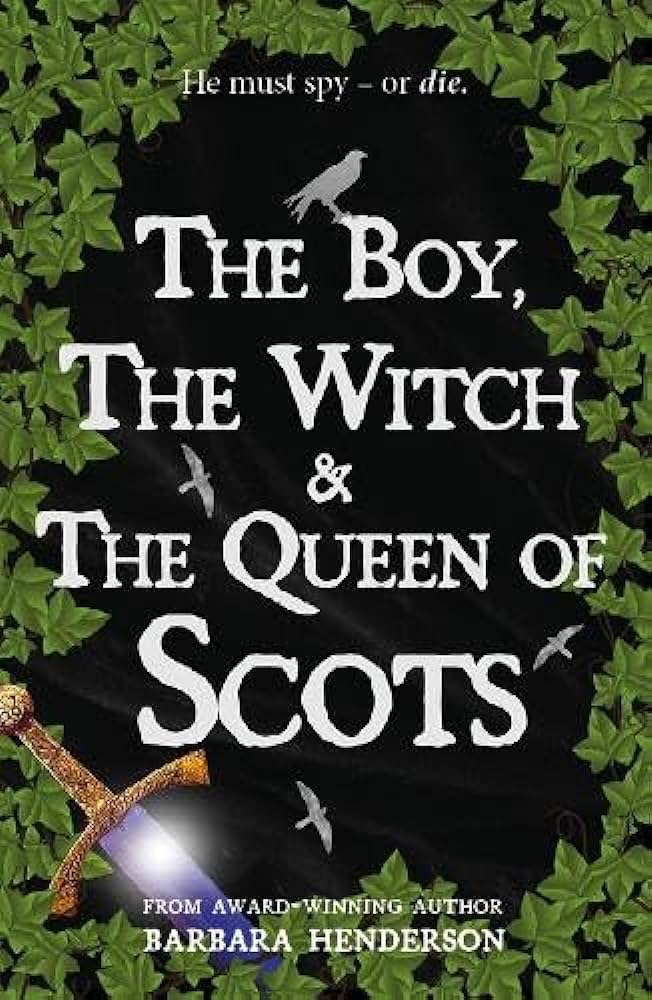
How could I resist? A witch, and Stirling. Barbara Henderson’s new book was clearly meant for me. And it is as with her other historical novels; I learned so much. It’s almost like going to school, except a lot more fun.
It’s 1561. Alexander is a trainee falconer and new to Edinburgh, when he just happens to be in Leith when Mary Queen of Scots arrives from France. The Earl of Huntly, for whom he used to work, has instructed him to spy on the Queen. He desperately wants to avoid this, but how?
Based on real events, in a way this is similar to some of the other Mary Queen of Scots books I have come across. This is good, because that way you learn by repetition, and then you can concentrate on what is special about this story.
The birds, and the need to spy on his Queen. Alexander’s friendship with Lizzie who is the Queen’s seamstress.
Mary travels a lot, now that she has arrived in Scotland, and there are many opportunities for bad things to happen. She has long struck me as an interesting young woman, and this was a great way of meeting up with Mary again.
I almost wish I was twelve, coming fresh to fun history. But being old is almost as good.
Poverty and disability, environmental disasters and their cause; it’s all here in Steve Cole’s new book for Barrington Stoke. Set in the Philippines, we meet Junjun and Gayla.
Junjun is so poor that he has to beg, and his family live under a bridge. Gayla has Cerebral Palsy and is trying to learn how to use an electric wheelchair while staying in a centre for children with disabilities. However, when the two meet, they are both pleased not to be like the other.
But when circumstances cause them to come together, as flood waters rise, they are forced to look at life through the other person’s eyes. And they have to cooperate. Well, strictly speaking, Junjun could have left Gayla behind, but he doesn’t.
So this is more than a friendship across the divides story. It shows the reader quite how bad things can get, and how it’s often worst ‘somewhere else.’ In Manila, not in the UK or Europe. The sharp illustrations by Oriol Vidal bring home what life elsewhere looks like.
Drowning in my Bedroom delivers on so many fronts and you learn much more than you thought you needed to. I hadn’t understood that some people don’t know what medicines are; how you get them and what they do, and what they don’t do.
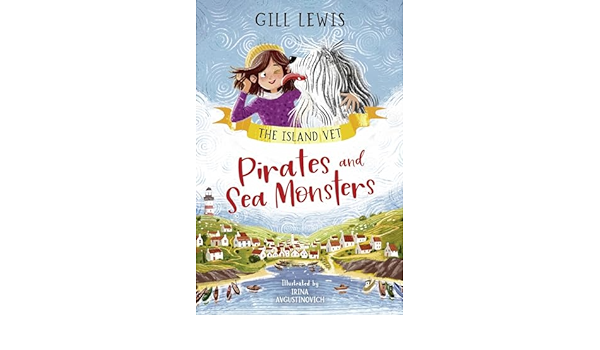
Living the dream. It’s what we all hope for, and in this new story for Barrington Stoke, Gill Lewis introduces us to Tia and her vet mum.
When life in the city gets too much, they are able to escape to a small island a long way away, where there is a need for a vet. And maybe Tia can even have her own cat?
What I especially like is how natural it is for there to be just the two of them, mother and daughter. And they are so close. This is of necessity a short novel, but you can tell that Gill knows about animals, about being a vet. It’s what makes the story feel true.
I have great hopes for Tia’s future, and may there be many more pets to look after.
Ten years on I see things differently. The online reminders of what happened on this date bring stuff back, and the memories of the move north helps me reflect on what my Bookwitchery caused.
I happened to mention on social media that the old Bookwitch Towers had sold, and how I now merely wanted for a new one to replace it. You know, those days when you’re waiting, holding breaths and crossing digits.
One of my online author friends said how she wanted a comfortable cave in Umbria, with cappuccino on tap (to paraphrase a little). Just knowing that one of ‘my’ authors was listening to my housing woes gave me a warm glow.
This led eldest Offspring to pitch in by mentioning Due South, the Chicago based television show that wasn’t filmed there. That in turn made my Umbrian wannabe very happy, hearing from another Due South fan, and she decided to pop downstairs to watch an episode. Because some people own the box set.
Finally another friend piped up to say she too was a Due South fan. Aren’t we all?
And I’d only aired my worries about having nowhere to live…




 The Occasional Bookwitch